
Burcu Yeşilbaş
Songs of the Mountain is far more than a documentary to me; it is a deeply personal journey into my childhood, my family’s roots, and the invisible memory carried across generations by the women of the Black Sea region. Though I grew up in Yalova, my mother and grandmother hail from Tonya. My most vivid childhood memories always trace back to these mountains, the steep highlands, and the stories shared within those homes. As a musician, I have sung the folksongs of this geography for years; as a filmmaker, I now trace the stories of women that have been carried in silence, unheard.
The door to this film was opened by a folk song called Dertlerim (My Sorrows). Sung by İlknur Yakupoğlu, it unexpectedly struck a chord with my own family’s past. Within that single song, I heard not just the sorrow of two mothers, but a collective memory kept alive by women who entrusted it to one another. From that day on, I realized that İlknur was not merely a musician singing folksongs; she was a female bard carrying the living memory of her geography upon her shoulders.
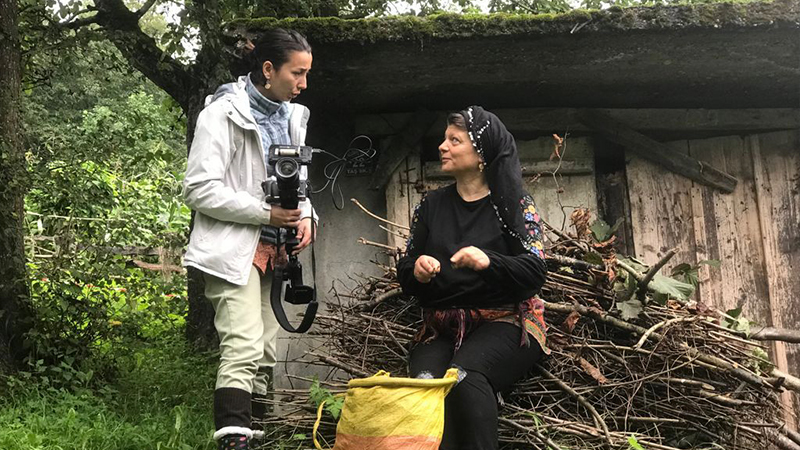
As the film unfolded, her story and mine began to intertwine. Every folksong I pursued guided me to another woman, another home, another memory. The closer I drew to my own family, the more I realized I was walking within a shared tapestry of women’s memory, carried invisibly through the years. This is why I chose to position myself in the film not as a detached, invisible observer, but as a witness passing through this very memory.
Songs of the Mountain is much more than the portrait of an artist. Behind the many folksongs deemed “anonymous” in the Black Sea today lie the voices of women who labored in the fields, tended to livestock, and raised children. Though their names have been erased by time, their melodies endure. This film is an earnest attempt to trace that unseen presence and labor.
In crafting the film’s visual language, I chose to navigate the fine line between the simplicity of observational cinema and poetic expression. Highlands dissolving into the mist, forests shaped by the wind, and the hands, faces, and silences of the women dictate the rhythm of the story. My background as a musician naturally made the soundscape an inseparable extension of the film. Rather than recreating the music within a studio, I chose to capture it alongside nature’s own breath; for I believe the true voice of these stories is hidden within the very spaces where they live.
Songs of the Mountain is a testament to women’s labor left in the shadows, to oral culture, and to the intergenerational solidarity passed down through the ages. For me, this film is not simply about documenting the past; it is about listening closely to a memory that is still vibrant and alive, and ensuring it is carried into the future.