
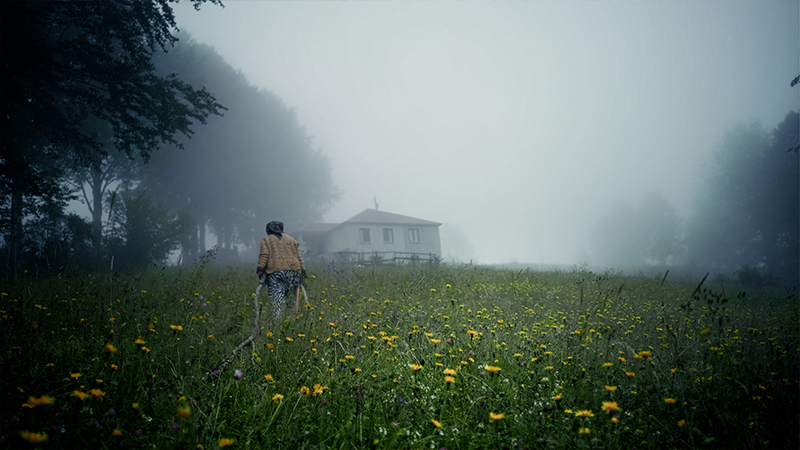
(Logline) As powerful melodies rise across the highlands, a musician and a filmmaker bring centuries-old women’s stories to this big wide world. Carried by the very tradition and soul of the mountains, these folk songs resonate far beyond their borders.
In the Black Sea highlands, daily life has been interwoven for millennia with women’s improvised songs. Rising from fields and barns, these sharp voices embody the living oral history of the land. Yet, playing the kemenche—a local instrument dominated by men—carried a heavy societal taboo during İlknur’s youth.
Contemporary female folk poet İlknur Yakupoğlu became a turning point that radically changed this perception by appearing on television screens with her kemenche; the path she forged allows women today to attend kemenche courses. This journey, which transforms tradition while carrying it forward, is completed through the gaze of director Burcu, whom we also see as a character in the film. Representing a younger generation with cultural roots in these lands but raised in western Turkey due to internal migration, Burcu constructs the film as an essay documentary, weaving her own observational camera into the narrative. Recorded with the raw sounds of wind and rain instead of sterile studios, this 42-minute film restores the creative genius of women—long left “anonymous”—to the primary subject identity it rightfully deserves.
Songs of the Mountain weaves a local testimony through the world of these women into the profound anthropological coherence of a universal mountain culture. The voices thrown from the highlands to the sky become the living, evolving local memory of an ancient global song that stretches from the Himalayas to the Alps and the Scottish Highlands.